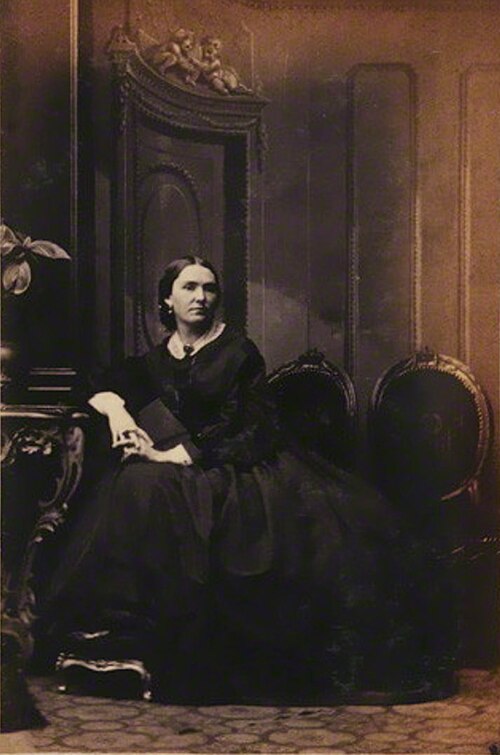
 Augusta Emily Becher (née Prinsep, October 1, 1830 - May 14, 1909) was a British chronicler, writer, and traveler whose posthumously published memoirs offer a valuable
first-hand glimpse into colonial life in 19th-century India and Europe.
Augusta Emily Becher (née Prinsep, October 1, 1830 - May 14, 1909) was a British chronicler, writer, and traveler whose posthumously published memoirs offer a valuable
first-hand glimpse into colonial life in 19th-century India and Europe.Queer Places:
Brookwood Cemetery, Brookwood, Surrey, GU24 0BL England
Augusta Emily Becher (née Prinsep, October 1, 1830 - May 14, 1909) was a British chronicler, writer, and traveler whose posthumously published memoirs offer a valuable
first-hand glimpse into colonial life in 19th-century India and Europe.
Augusta was born into the prominent and intellectually accomplished Prinsep family. Her father, Augustus Prinsep, was an artist, writer, and civil servant in the East India Company. Seeking a cure for his failing health, Augustus embarked on a voyage toward England with his pregnant wife, Elizabeth Acworth Ommanney.
Tragedy struck off the coast of South Africa: Augusta was born at sea on October 1, 1830, and her father succumbed to tuberculosis just nine days later on October 10. Raised in England by her widowed mother (who later remarried architect Samuel Beachcroft), Augusta grew up in a household deeply connected to British imperial administration and art.
On May 15, 1849, Augusta married Septimus Harding Becher, an officer in the Bengal Staff Corps. Less than a month after their wedding, they sailed for India, arriving in late October 1849.
Over the next few decades, Augusta accompanied her husband to various military stations across India, including Simla, Barrackpore, and Calcutta. Septimus rose steadily through the military ranks, eventually retiring as a full General. Together, they had ten children, though the harsh colonial environment took a heavy toll, and four of their children died in infancy.
Augusta lived through one of the most turbulent periods of British colonial rule: the Indian Rebellion of 1857 (also known as the Indian Mutiny). Because of her husband’s high-ranking staff positions, she was privy to the early, tense whispers of unrest. Her journals detail the mounting anxieties, military maneuvers, and the sheer terror experienced by civilian families as the conflict spread across the subcontinent.
After decades of service, the family returned to Europe. Augusta was an avid traveler and observer of continental events. She lived in Dresden, Germany, during the outbreak of the Franco-Prussian War (1870) and was staying near Naples, Italy, during the massive 1872 eruption of Mount Vesuvius.
The family eventually settled back in England, living quietly in Paddington, London. General Becher passed away in 1908, and Augusta died just a year later on May 14, 1909, while staying at the Coburg Hotel in London.
Augusta began compiling her journals and writing her memoir in 1884, completing the bulk of it before adding a short, reflective sequel in 1902.
In 1930, her writings were compiled and published posthumously as Personal Reminiscences of India and Europe, featuring an introduction by the historian H.G. Rawlinson. Today, her memoir is highly regarded by historians as a remarkably candid, witty, and valuable social document that vividly portrays Anglo-Indian domestic life, the anxieties of the 1857 rebellion, and the realities of Victorian-era travel.
Annie Besant wrote in her autobiography about the "idolatry" she felt for her mother, generalizing:
"All girls have in them the germ of passion. . . . I had but two ideals in my childhood and youth, round whom twined these budding tendrils of passion: they were my mother and the Christ."
Queer and feminist historians point to Besant and her contemporaries to argue that homoeroticism and intense romantic bonds between women in the 19th century were not uniform indicators of modern "sexual orientation."
Consider how this intense mother-daughter and female-to-female adoration manifested in the lives of her peers:
Annie Besant: A "sexual radical" who advocated for contraceptive rights and challenged traditional marriage, but found her deepest passions in maternal devotion, spiritual unions, and political crusades.
Edith Simcox: A writer and social reformer who lived a life of intense, unrequited romantic devotion to the novelist George Eliot (Mary Ann Evans).
Frances Power Cobbe: A prominent suffragist who lived in a devoted, recognized domestic partnership (what some call a "Boston marriage") with sculptor Mary Lloyd for over thirty years.
Ethel Smyth: An English composer and suffragette who was openly passionate in her letters, having numerous romantic affairs with women (including Virginia Woolf) and occasionally men.
Augusta Becher: Had an identical emotional blueprint of maternal "idolatry" in youth, but followed a traditional heterosexual path, marrying a man.
References:
 Between Women: Friendship, Desire, and Marriage in Victorian England Paperback – January 22, 2007 by Sharon Marcus |
Other references:
Support this project
This website is a passion project researched, developed, and funded entirely by me. If you find the content valuable and would like to help support the ongoing research and hosting costs, any contribution is deeply appreciated.
Thank you for keeping this independent resource alive!
My books on Amazon: Elisa Rolle's books